
Category: Tax
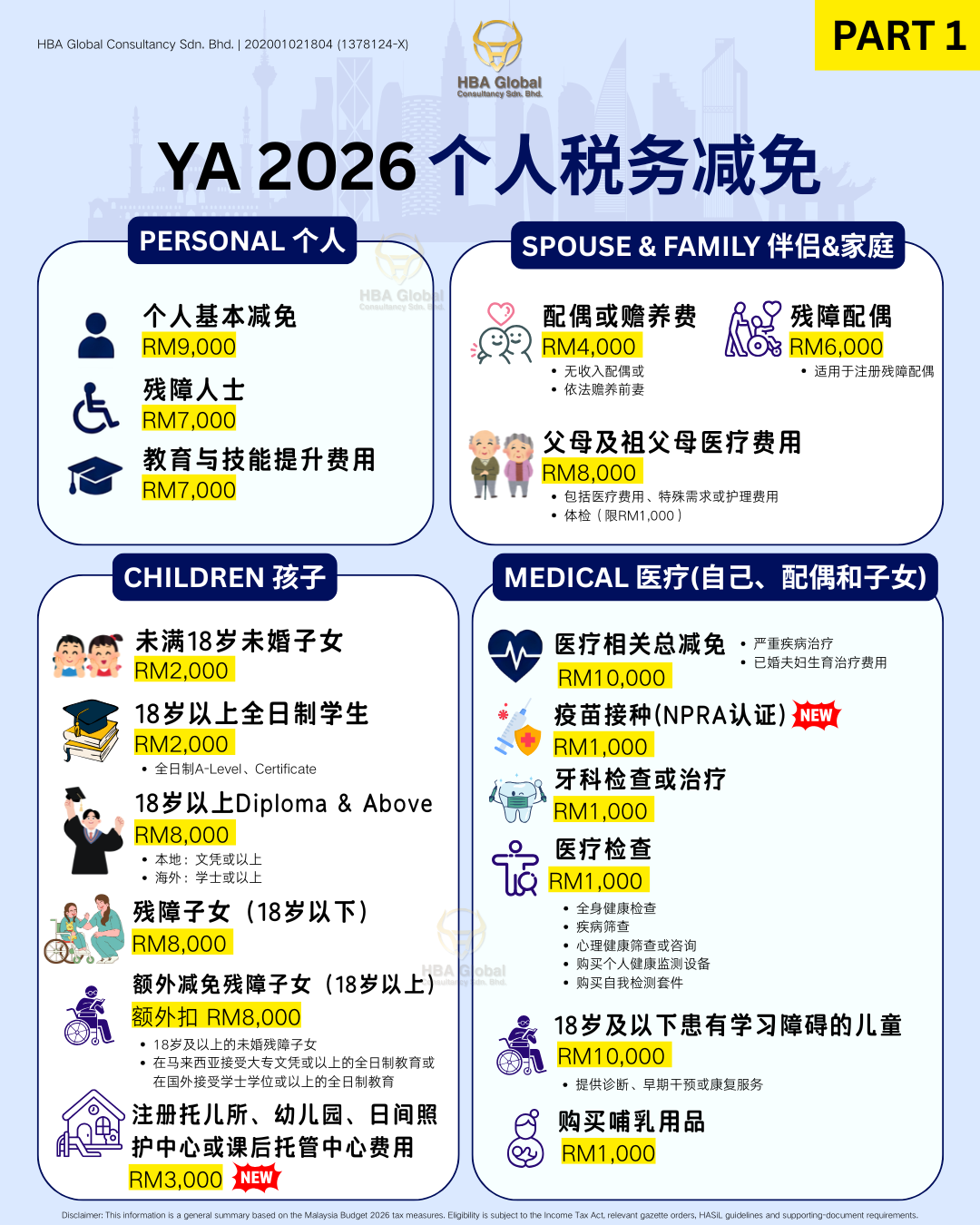
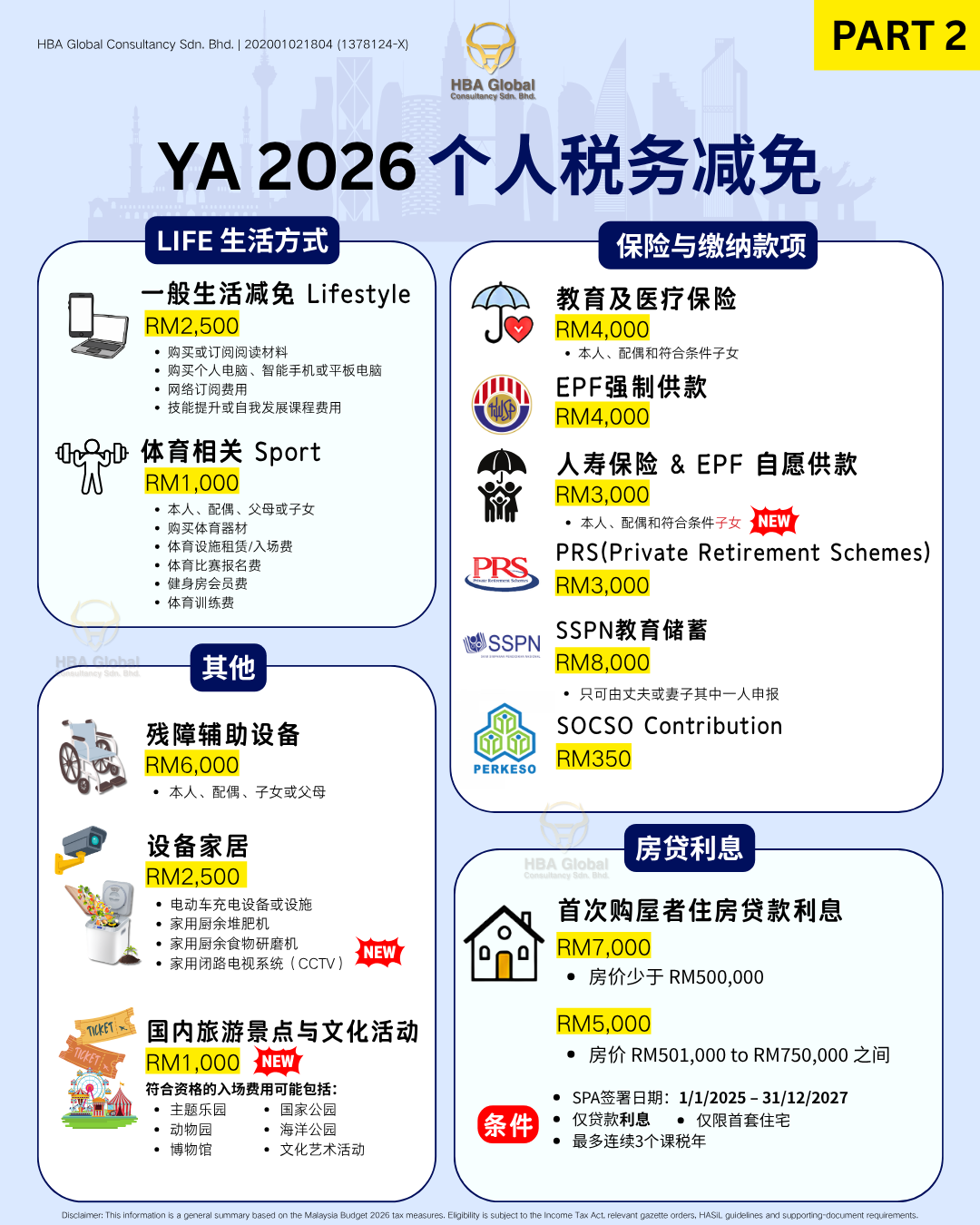
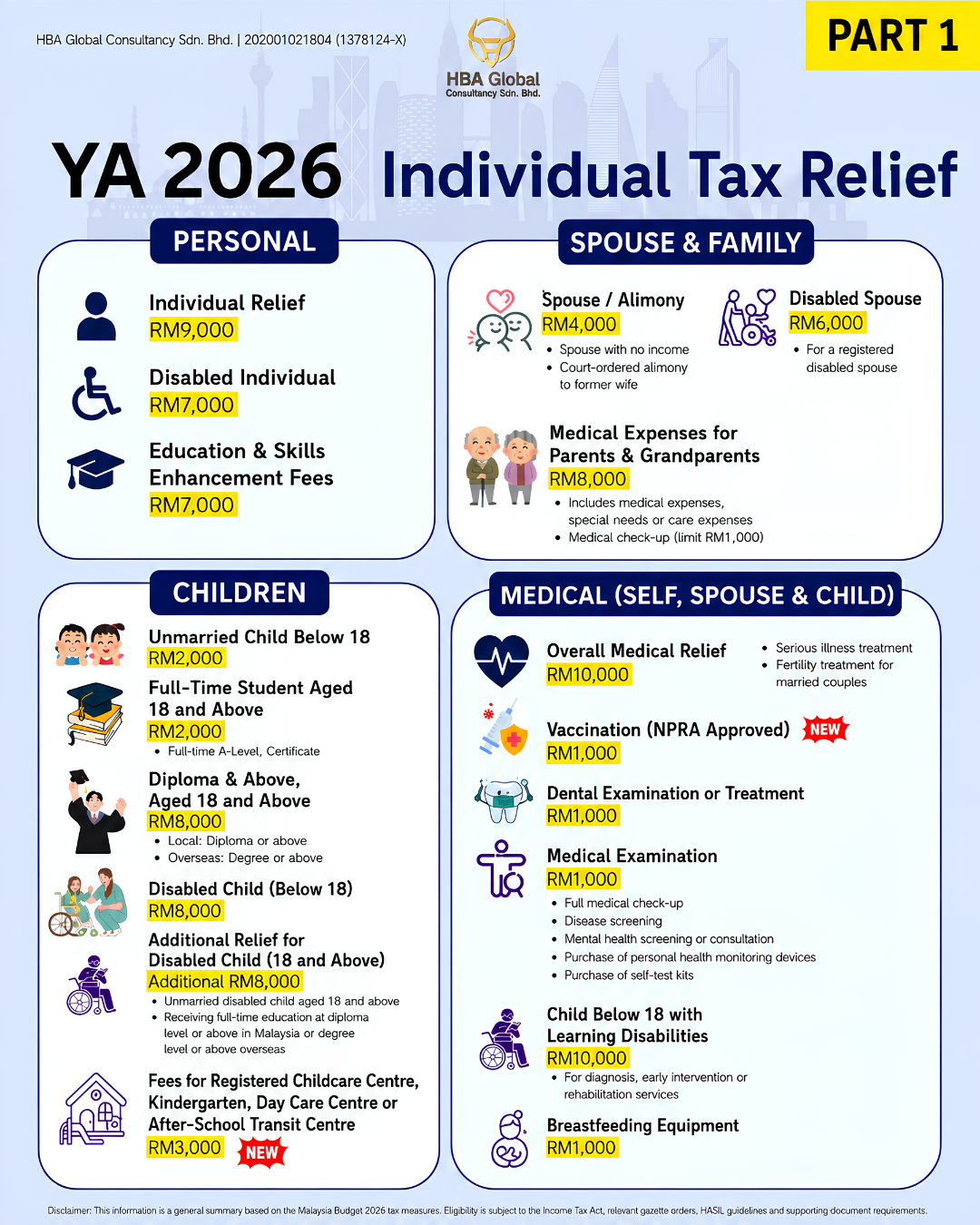
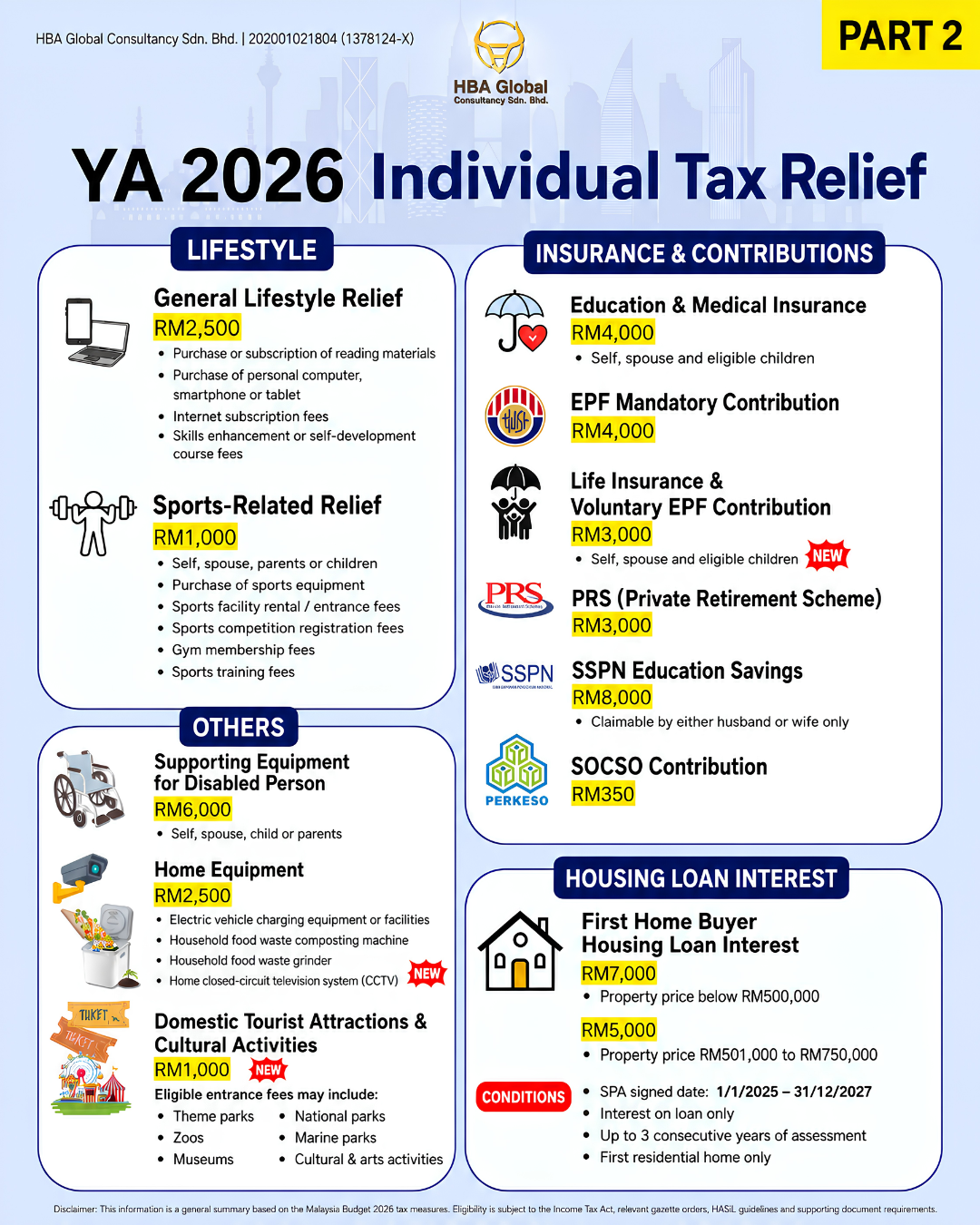
Malaysia Personal Income Tax Relief 2026
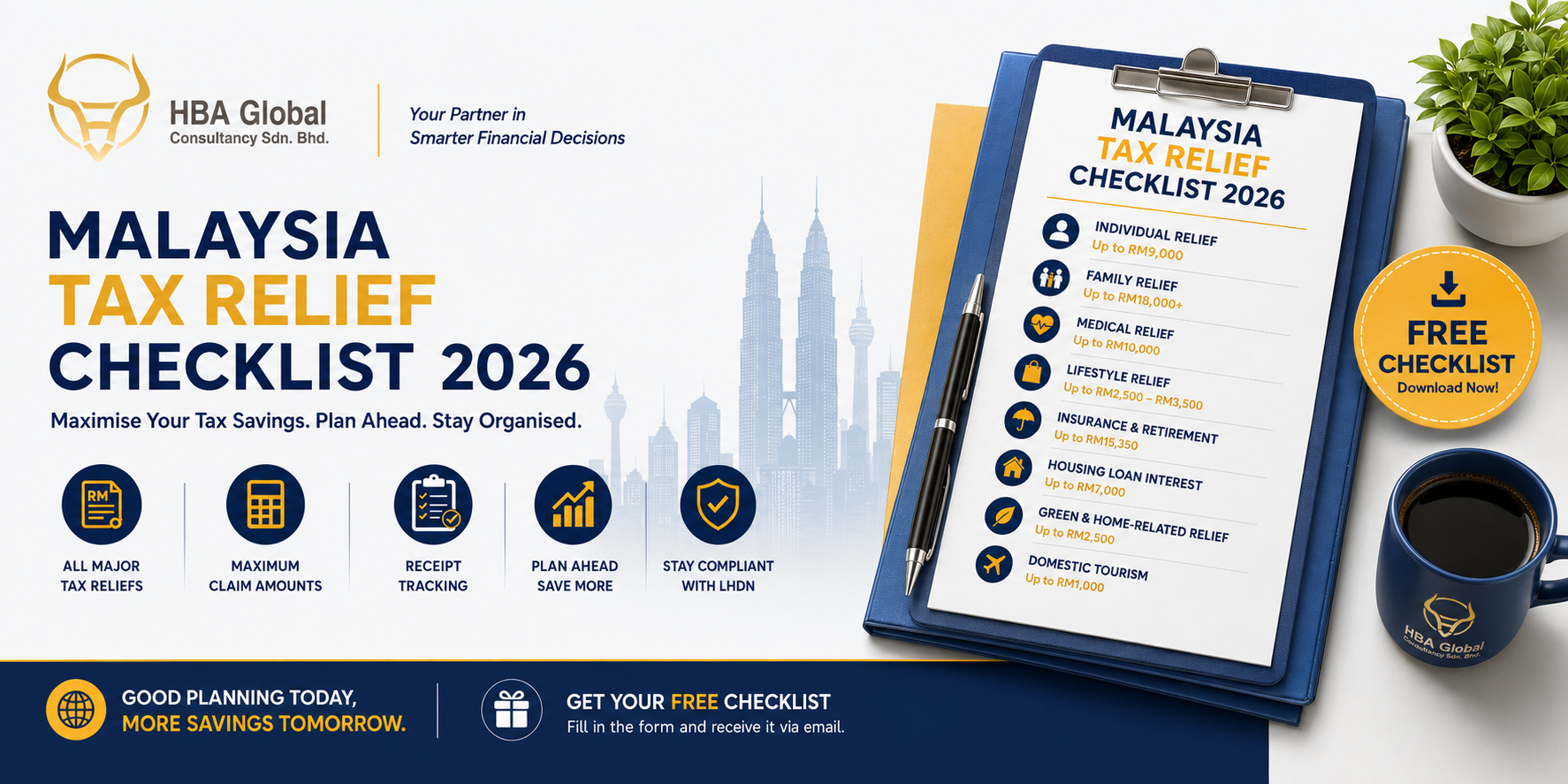
🇲🇾 Malaysia Personal Income Tax Relief 2026: What Can You Claim? (Complete Guide)
Published: August 2026
Every year, thousands of Malaysians pay more tax than necessary, not because they earn more, but because they miss out on eligible tax reliefs.
From education fees and insurance premiums to medical expenses and lifestyle purchases, many everyday expenses may qualify for tax relief if you meet the eligibility requirements.
Here's a summary of some of the most important tax reliefs you should know.
1. 👤 Individual Relief
🔹Individual Relief:
Maximum Relief: RM9,000
Every resident individual taxpayer is automatically entitled to an RM9,000 personal tax relief.
🔹Disabled Individual:
Maximum Relief: RM7,000
Available for taxpayers registered as Persons with Disabilities (OKU).
🔹Self-Education Fees:
Maximum Relief: RM7,000
Claimable for approved education programmes, including:
Diploma, Degree, Master's & PhD
Professional qualifications
Approved skills enhancement courses
Self-enhancement courses are included within the RM7,000 limit.
2. 👨👩👧 Family Relief
🔹Dependent Spouse:
Maximum Relief: RM4,000
Available if your spouse has no income or if you make qualifying alimony payments.
🔹Disabled Spouse:
Maximum Relief: RM6,000
Additional relief for taxpayers supporting a disabled spouse.
🔹Parents & Grandparents' Medical Expenses:
Maximum Relief: RM8,000
Eligible expenses include:
Medical treatment
Dental treatment
Nursing care
Health screening (up to RM1,000)
Vaccination (up to RM1,000)
3. 👶 Child Relief
Depending on your child's age and education level, you may qualify for:
4. 🏥 Medical Relief
Combined Maximum Relief: RM10,000
Medical relief may cover:
Serious diseases
Fertility treatment
Vaccination
Health screening
Dental treatment
Mental health screening
Early intervention programmes
Rehabilitation for children with special needs
Several sub-categories share the same RM10,000 overall limit.
5. 💻 Lifestyle Relief
🔹Lifestyle Relief:
Maximum Relief: RM2,500
Examples include:
Books
Newspapers
Computers
Laptops
Smartphones
Tablets
Internet subscription
Self-improvement courses
🔹Sports Lifestyle:
Maximum Relief: RM1,000
Eligible expenses include:
Sports equipment
Gym memberships
Sports facility fees
Marathon or competition registration fees
Coaching or training programmes
6. ☂️Insurance & Retirement
These reliefs can significantly reduce your taxable income if planned properly.
7. ⚡ Green & Home Incentives
Several environmentally friendly purchases also qualify for tax relief.
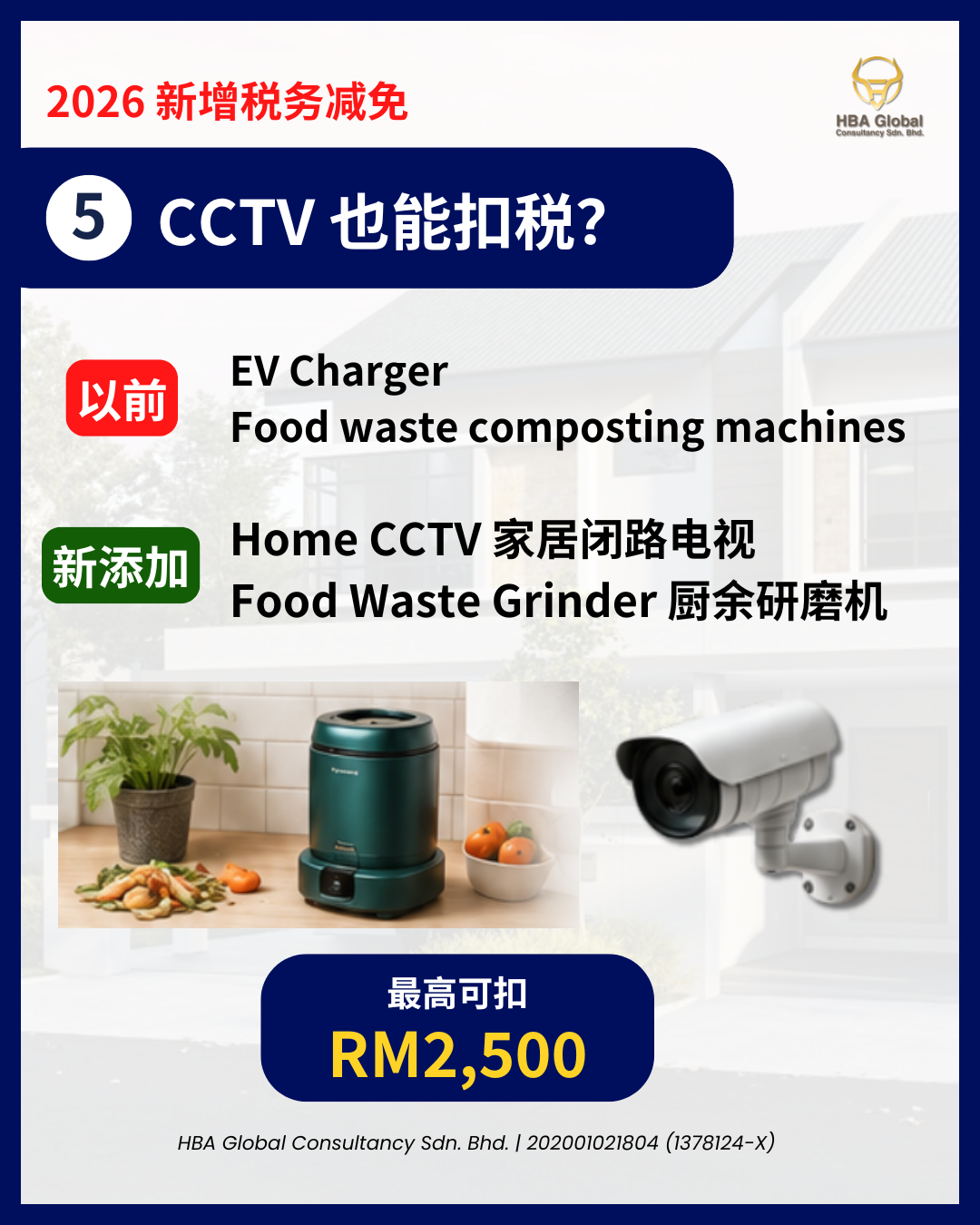
Maximum Relief: RM2,500
Examples include:
EV Charging Equipment
Home CCTV
Food Waste Composters
Food Waste Disposal Machines
8. 🏠 First Home Housing Loan Interest
If you're a first-time homebuyer, you may qualify for housing loan interest relief.
The relief is available for up to three consecutive years, subject to the qualifying conditions.
9. 🎡Domestic Tourism
Maximum Relief: RM1,000
You may claim Entrance Fees paid for selected attractions, including:
Theme park
Zoo
Museum
National Park
Marine Park
Cultural and arts event
Why Most People Miss Their Tax Relief
Many taxpayers only start collecting receipts when tax filing season arrives.
Unfortunately, by then:
❌ Some receipts are already missing.
❌ Important expenses have been forgotten.
❌ Supporting documents are incomplete.
Good tax planning starts throughout the year, not at the last minute.
🎁 FREE Malaysia Tax Relief Planning Checklist
To help you keep track of your eligible expenses, HBA Global Consultancy has prepared a FREE Malaysia Personal Income Tax Relief Planning Checklist.
The checklist includes:
✅ Every major tax relief category
✅ Maximum claimable amount
✅ Receipt tracking section
✅ Payment tracking
✅ Personal planning notes
Perfect for employees, freelancers, business owners, and anyone who wants to maximise their tax savings.
📥 Download Your FREE Checklist:
Want to stay organised and avoid missing valuable tax relief?
Click the link below to get your FREE Malaysia Tax Relief Planning Checklist:
Simply complete our short Google Form:
Full Name
Contact Number
Email Address
📩 Once submitted, we'll send the checklist directly to your email.
👉 Submit Here: https://forms.gle/CBKxFbnrH6Yryf6X8
Need Help with Personal Tax Planning?
Our tax specialists can help you:
Review your tax relief eligibility
Maximise your tax savings
Ensure compliance with LHDN requirements
Plan your taxes more effectively
📞 Contact HBA Global Consultancy today to learn more about our personal tax advisory services.
Disclaimer
The information provided in this article is for general informational purposes only and should not be regarded as tax, legal, or professional advice.
The availability and eligibility of Malaysian personal income tax reliefs are subject to the Income Tax Act 1967, the latest Lembaga Hasil Dalam Negeri Malaysia (LHDN) guidelines, annual Finance Acts, gazette orders, and any subsequent amendments issued by the Malaysian Government.
Tax relief amounts, qualifying conditions, and claim requirements may change from time to time. Individual circumstances may also affect eligibility.
While every effort has been made to ensure the accuracy of the information at the time of publication, HBA Global Consultancy Sdn. Bhd. accepts no responsibility for any loss or liability arising from reliance on this article.
For advice tailored to your personal tax situation, please consult a qualified tax professional before making any tax-related decisions.
2026 New Tax Relief – Illustration



Disclaimer
The information provided in this article is intended for general educational and informational purposes only. While every effort has been made to ensure the accuracy of the information at the time of publication, tax laws, reliefs, eligibility criteria, administrative practices, and implementation guidelines may be revised, updated, or clarified by the Inland Revenue Board of Malaysia (LHDN) from time to time.
The tax reliefs, limits, examples, and explanations discussed in this article are based on publicly available information relating to Budget 2026 proposals and announcements. The actual eligibility, qualifying conditions, supporting documentation requirements, and claim procedures may vary depending on an individual's circumstances and the latest guidance issued by LHDN.
Readers are strongly advised to refer to the latest official publications, guidelines, FAQs, Public Rulings, and announcements issued by LHDN before making any tax-related decisions or submitting their income tax returns.
This article should not be construed as tax, legal, financial, or professional advice. HBA Global Consultancy Sdn. Bhd. shall not be held responsible for any loss, liability, or consequences arising from reliance on the information contained in this article without obtaining professional advice tailored to specific circumstances.
For the most up-to-date information, please refer directly to LHDN's official website and published guidance.
2026 新增税务减免
马来西亚 2026 年税务减免更新:你不可错过的 6 项新变化
随着 2026 年已经过半,许多纳税人可能已经在某些项目上消费,却不知道这些开销有机会在明年报税时申请税务减免(Tax Relief)。
每年马来西亚财政预算案(Budget)都会针对个人所得税减免项目作出调整。有些更新广受关注,但也有不少新措施往往要等到报税季来临时,大家才发现自己原来符合资格。
然而到了报税时,许多人却发现:
收据(Receipt)已经遗失
e-Invoice 找不到了
支持文件不完整
为了让大家提早做好准备,我们整理了 Budget 2026 中 6 项值得关注的税务减免更新。
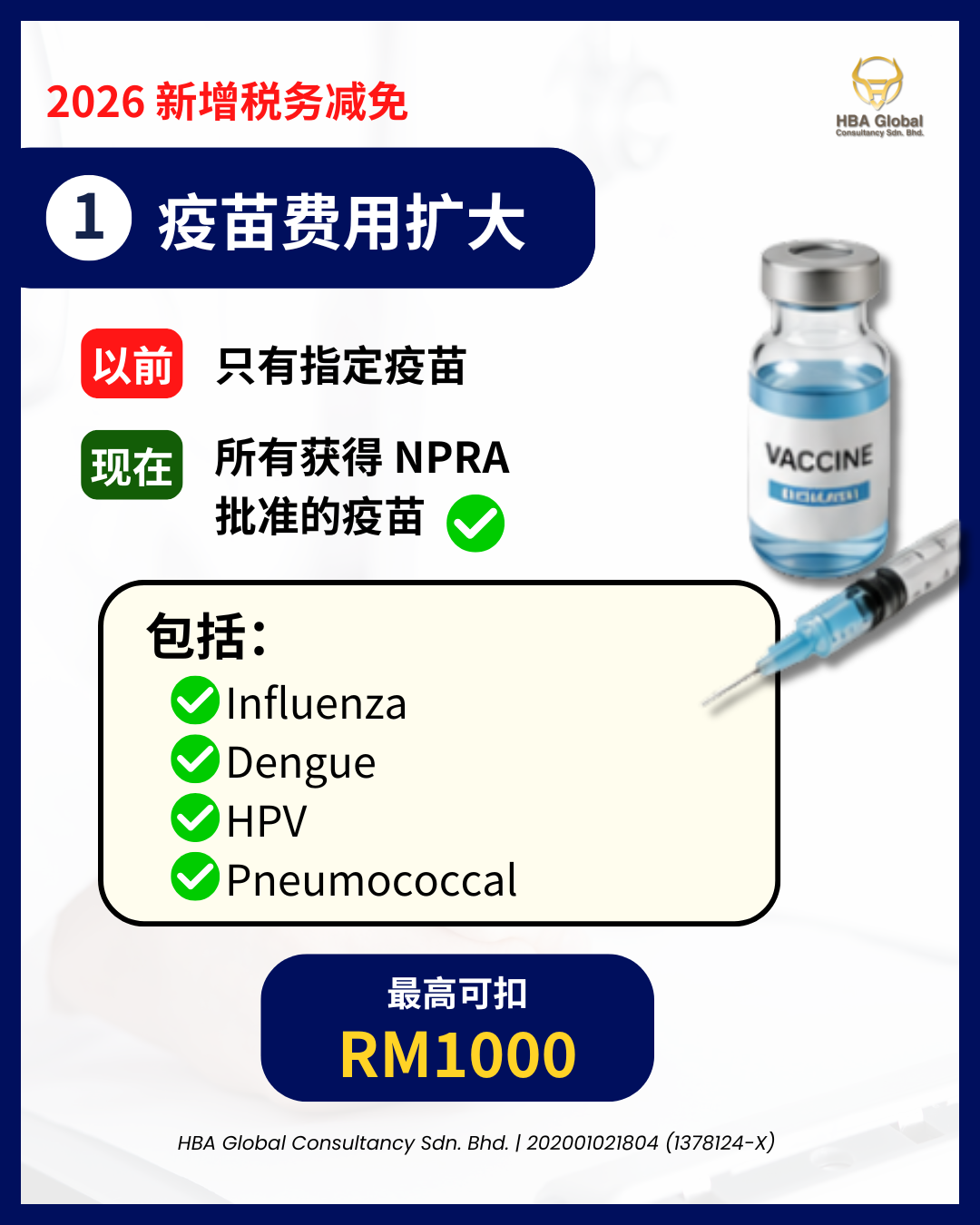
1. 疫苗费用税务减免扩大
过去,只有指定疫苗符合税务减免资格。
从 2026 估税年(YA 2026)开始,减免范围扩大至所有获得国家药剂监管局(NPRA)批准的疫苗。
例如:
流感疫苗(Influenza)
骨痛热症疫苗(Dengue)
HPV 疫苗
肺炎球菌疫苗(Pneumococcal)
其他经 NPRA 批准的疫苗
此项减免属于医疗费用相关减免项目,纳税人只需保留完整的付款记录及相关证明文件,即有机会申请税务减免。
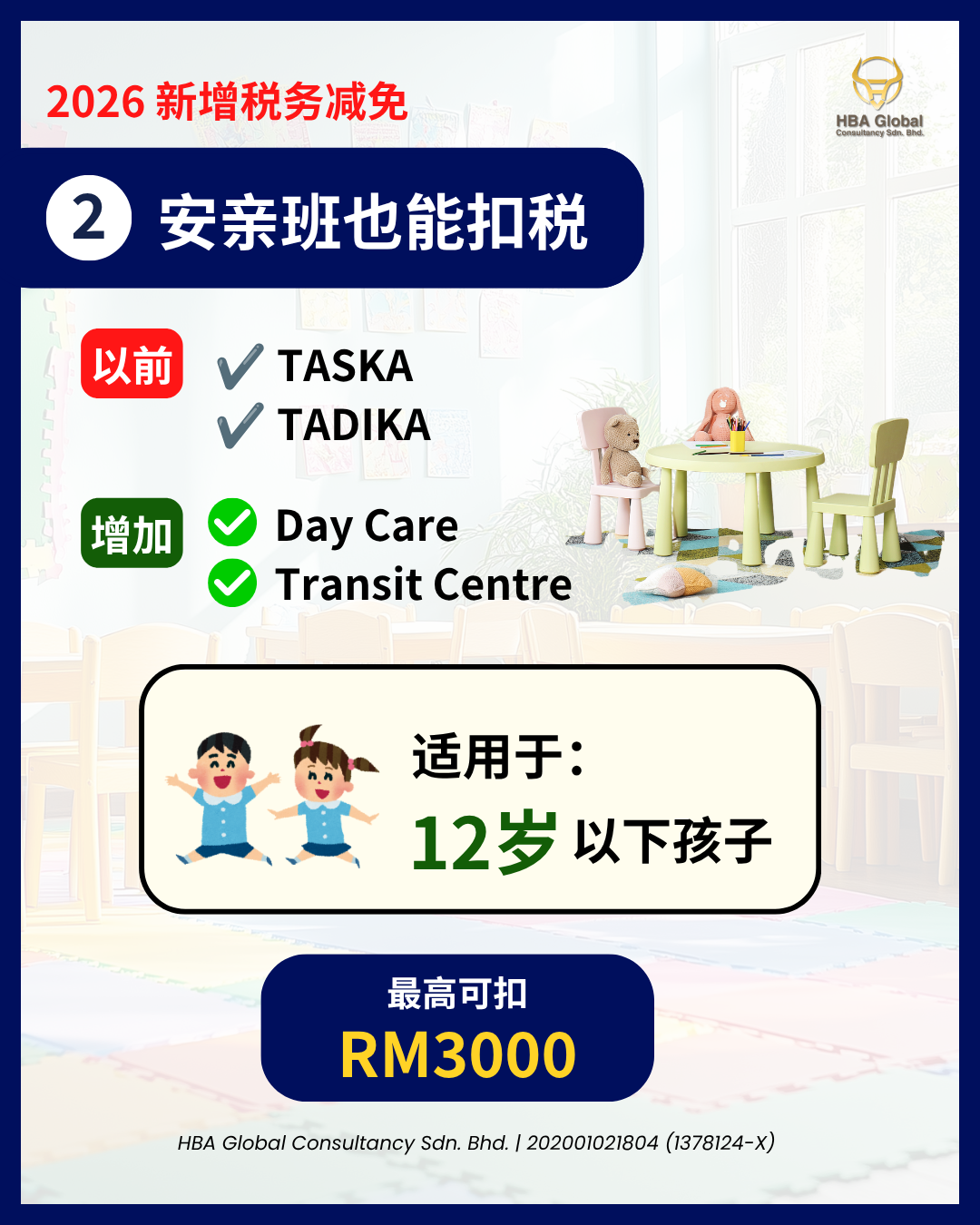
2. 安亲班与托管中心也纳入减免范围
对于有孩子的家庭来说,这是一项值得关注的更新。
过去,税务减免一般仅适用于:
注册托儿所(TASKA)
幼儿园(TADIKA)
从 YA 2026 开始,以下机构也纳入减免范围:
Day Care Centre(托管中心)
Transit Centre(安亲班)
这项调整有助于减轻双薪家庭及需要课后照顾服务家庭的经济负担。
建议家长妥善保存相关学费收据及付款记录,以便未来报税时使用。
3. 孩子的人寿保险与Takaful保险也符合资格
这是许多人容易忽略的一项更新。
过去,人寿保险税务减免主要适用于:
纳税人本人
配偶
从 YA 2026 开始,符合资格的孩子人寿保险(Life Insurance)及伊斯兰保险(Takaful)保费,也可纳入现有减免范围。
需要特别注意的是:
这并不是新增 RM3,000 的减免项目,而是现有 RM3,000 人寿保险减免的适用范围扩大至符合条件的孩子。
因此,家长应妥善保留保单及保费付款记录,以备报税时申报。
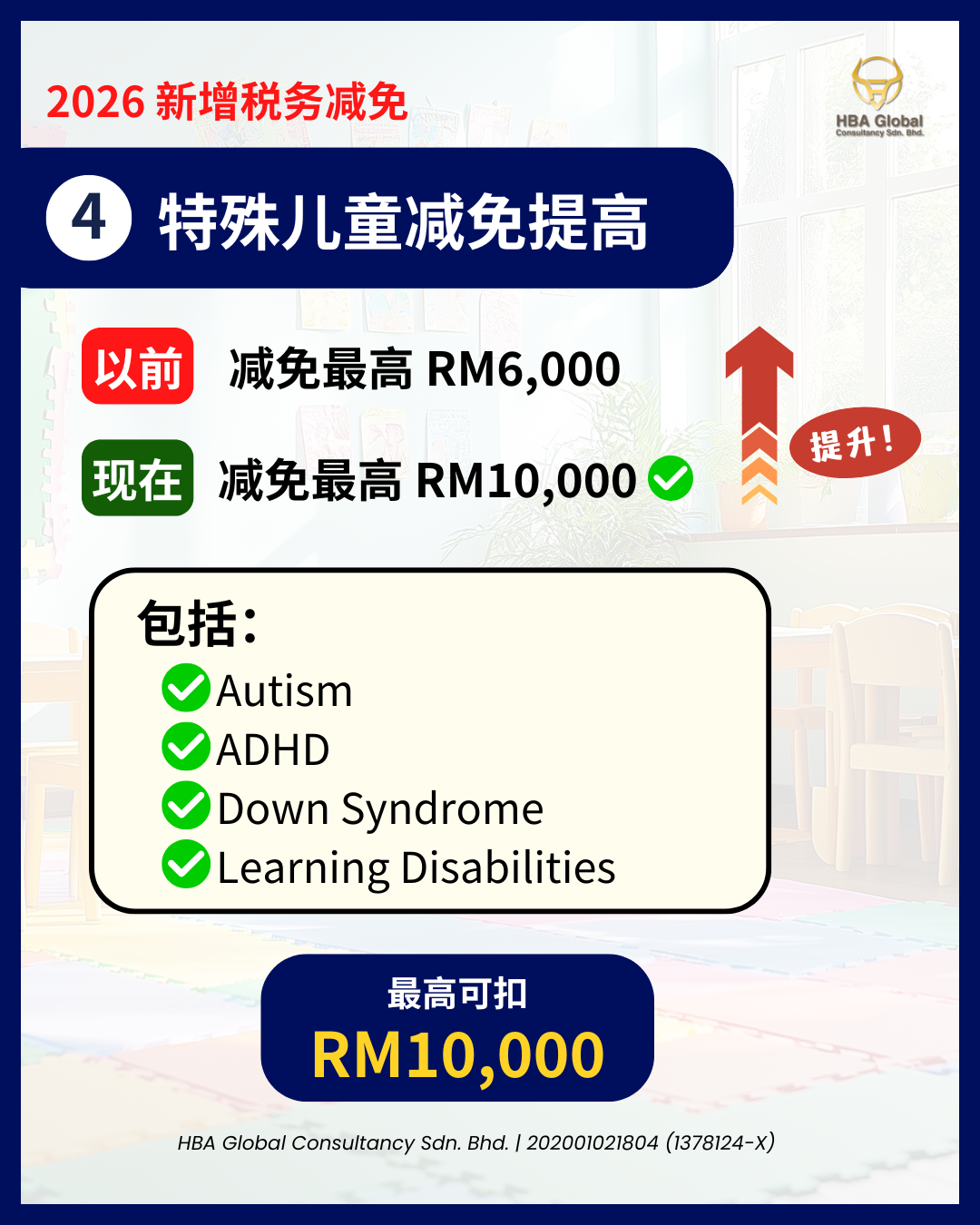
4. 特殊儿童税务减免提高
照顾特殊需求儿童的家庭将获得更高的税务减免。
减免金额由原本的:
RM6,000
提高至:
RM10,000
适用于符合资格的情况,例如:
自闭症(Autism Spectrum Disorder)
过动症(ADHD)
唐氏综合症(Down Syndrome)
发育迟缓(Global Developmental Delay)
学习障碍(Learning Disabilities)
其他获认可的发展障碍
这项提升反映政府持续加强对特殊家庭的支持。
5. Home CCTV 与 Food Waste Grinder 纳入减免
Budget 2026 也为家庭用户带来一项实用更新。
以下项目现已纳入相关税务减免范围:
Home CCTV(家居闭路电视)
Food Waste Grinder(厨余粉碎机)
此前符合资格的项目包括:
电动车充电器(EV Charger)
厨余堆肥机(Food Waste Composting Machine)
如果您计划提升家居安全或改善环保设施,记得保留购买发票及安装记录。
6. 指定国内旅游景点门票可享减免
配合 2026 马来西亚旅游年(Visit Malaysia Year 2026),政府新增部分国内旅游相关减免。
符合资格的景点包括:
主题乐园(Theme Park)
动物园(Zoo)
博物馆(Museum)
国家公园(National Park)
海洋公园(Marine Park)
文化活动(Cultural Programme)
换句话说,部分休闲娱乐活动除了丰富生活体验,也可能帮助您获得税务减免。
建议保留门票、付款记录及相关文件作为支持资料。
为什么现在就应该开始整理收据?
许多纳税人最大的错误,就是等到报税季才开始整理资料。
到了那个时候:
❌ 收据不见了
❌ e-Invoice 被删除了
❌ 银行记录找不到了
最好的做法,是从现在开始建立专属资料夹,无论是实体文件夹或电子档案夹,都能帮助您更有效管理相关文件。
建议保留的文件
针对 YA 2026,建议保留以下资料:
疫苗费用收据
安亲班及托管中心收费记录
孩子保险保费记录
特殊儿童相关医疗及教育费用文件
Home CCTV 购买记录
国内旅游景点门票
e-Invoice
收据及付款证明
根据马来西亚税务规定,相关文件一般应保存至少七年。
总结
税务减免看似只是报税过程中的一个小环节,但若善加利用,往往能够有效降低应课税收入。
重点不是等到明年报税时才研究,而是从现在开始了解相关政策,并妥善保存文件。
这样不仅能避免遗漏符合资格的减免项目,也能让未来报税过程更加顺利。
如果您不确定某项开销是否符合税务减免资格,建议在报税前咨询专业税务顾问。
需要税务规划协助?
HBA Global Consultancy 致力于协助个人及企业了解税务责任,并在符合 LHDN 规定的前提下,善用合法税务减免。
我们拥有超过 12 年经验,并服务接近 800 家企业。
✔ 会计服务(Accounting)
✔ 税务服务(Tax)
✔ 公司秘书服务(Company Secretary)
✔ 审计服务(Audit)
欢迎联系我们了解更多详情。
免责声明(Disclaimer)
本文内容仅供一般教育及资讯用途参考。
尽管我们已尽力确保本文发布时所载资料的准确性,但税务法令、税务减免项目、资格条件、行政程序及执行指南可能会因马来西亚内陆税收局(LHDN)后续公布的最新指南、常见问题(FAQ)、公共裁决(Public Ruling)或其他官方公告而有所修改、更新或进一步说明。
本文所提及的税务减免项目、限额、案例及解释,均依据 Budget 2026 公布资料及公开信息整理。实际适用资格、申报条件、所需支持文件及申请方式,仍须以 LHDN 最新官方指南为准。
读者在作出任何税务决定或提交报税表前,建议查阅 LHDN 最新发布的官方资料及相关指南。
本文内容不构成税务、法律、财务或其他专业意见。HBA Global Consultancy Sdn. Bhd. 对因依赖本文内容而产生的任何损失、责任或后果概不负责。
如需最新及最准确的信息,请以 LHDN 官方网站及最新发布文件为准。
2026 New Tax Relief
2026 Tax Relief Updates in Malaysia: 6 New Changes You Should Know
As we move through 2026, many taxpayers may already be spending on items that qualify for tax relief without realizing it.
Every year, Malaysia's Budget introduces changes to personal income tax reliefs. Some updates receive significant attention, while others go unnoticed until tax filing season arrives.
By then, many taxpayers discover that receipts have been misplaced, e-Invoices cannot be found, or supporting documents are incomplete.
To help you prepare early, here are six notable tax relief updates introduced under Budget 2026.
1. Expanded Tax Relief for Vaccination Expenses
Previously, only selected vaccines qualified for tax relief.
For YA 2026, the scope has been expanded to include vaccines approved by the National Pharmaceutical Regulatory Agency (NPRA).
Examples include:
Influenza Vaccine
Dengue Vaccine
HPV Vaccine
Pneumococcal Vaccine
Other approved vaccines
This relief falls under the medical expenses category and may help reduce your taxable income when supported by proper documentation.
2. Day Care and Transit Centres Are Now Eligible
Working parents may benefit from this update.
Previously, tax relief was generally available for fees paid to registered childcare centres (TASKA) and kindergartens (TADIKA).
The relief now includes:
Day Care Centres
Transit Centres
This expansion provides additional support for parents who rely on after-school care services for their children.
Be sure to keep payment records and receipts issued by the childcare provider.
3. Children's Life Insurance and Takaful Now Qualify
One of the lesser-known updates involves life insurance tax relief.
Previously, the relief mainly covered insurance premiums relating to the taxpayer and spouse.
Under the updated rules, eligible premiums paid for children's life insurance and children's takaful plans may also qualify under the existing relief framework.
It is important to understand that this is not a new relief category. Instead, the scope of the existing relief has been expanded.
Parents are encouraged to retain policy documents and premium payment records for future tax filing purposes.
4. Higher Relief for Special Needs Children
Families caring for children with special needs will benefit from an increased relief amount.
The allowable relief has been increased from RM6,000 to RM10,000.
This applies to qualifying conditions such as:
Autism Spectrum Disorder (ASD)
Attention Deficit Hyperactivity Disorder (ADHD)
Down Syndrome
Global Developmental Delay (GDD)
Learning Disabilities
Other recognised developmental conditions
This enhancement reflects the government's continued effort to support families facing higher medical and educational expenses.
5. Home CCTV and Food Waste Grinders Added
Budget 2026 also introduces a practical update for homeowners.
The following items may now qualify under the relevant tax relief category:
Home CCTV Systems
Food Waste Grinders
These are in addition to previously eligible items such as electric vehicle chargers and food waste composting machines.
If you are planning home security or sustainability improvements, remember to retain the purchase invoice and installation records.
6. Selected Domestic Tourism Attractions May Qualify
In conjunction with Visit Malaysia Year 2026, selected tourism-related expenses may qualify for tax relief.
Examples include:
Theme Parks
Zoos
Museums
National Parks
Marine Parks
Cultural Programmes
Certain leisure activities may therefore contribute towards tax savings while supporting Malaysia's tourism industry.
Taxpayers should retain tickets, receipts, and payment records as supporting documents.
Why You Should Start Organising Your Receipts Now
One of the most common mistakes taxpayers make is waiting until tax filing season before reviewing their expenses.
By that time:
Receipts may have been misplaced
e-Invoices may have been deleted
Payment records may be difficult to retrieve
The best approach is to create a dedicated folder, either physical or digital, and store all relevant tax documents throughout the year.
Documents You Should Keep
For YA 2026, consider keeping records for:
Vaccination Expenses
Childcare and Transit Centre Fees
Children's Insurance Premiums
Special Needs Child Treatment Expenses
Home CCTV Purchases
Domestic Tourism Attraction Tickets
e-Invoices
Payment Receipts
Under Malaysian tax regulations, supporting documents should generally be retained for at least seven years.
Final Thoughts
Tax reliefs may seem like a small part of financial planning, but they can significantly reduce your taxable income when utilised correctly.
The key is preparation.
Understanding the available tax reliefs now allows you to make informed spending decisions and avoid missing out on legitimate tax savings later.
If you are unsure whether a particular expense qualifies for tax relief, it is always advisable to seek professional tax advice before filing your tax return.
Need Help With Personal Tax Planning?
At HBA Global Consultancy, we assist individuals and businesses in understanding their tax obligations while maximising available tax reliefs in compliance with LHDN requirements.
With more than 12 years of experience and nearly 800 businesses served, our team is ready to help.
✔ Accounting
✔ Tax
✔ Company Secretary
✔ Audit
Contact us today to learn more.
Disclaimer
The information provided in this article is intended for general educational and informational purposes only. While every effort has been made to ensure the accuracy of the information at the time of publication, tax laws, reliefs, eligibility criteria, administrative practices, and implementation guidelines may be revised, updated, or clarified by the Inland Revenue Board of Malaysia (LHDN) from time to time.
The tax reliefs, limits, examples, and explanations discussed in this article are based on publicly available information relating to Budget 2026 proposals and announcements. The actual eligibility, qualifying conditions, supporting documentation requirements, and claim procedures may vary depending on an individual's circumstances and the latest guidance issued by LHDN.
Readers are strongly advised to refer to the latest official publications, guidelines, FAQs, Public Rulings, and announcements issued by LHDN before making any tax-related decisions or submitting their income tax returns.
This article should not be construed as tax, legal, financial, or professional advice. HBA Global Consultancy Sdn. Bhd. shall not be held responsible for any loss, liability, or consequences arising from reliance on the information contained in this article without obtaining professional advice tailored to specific circumstances.
For the most up-to-date information, please refer directly to LHDN's official website and published guidance.
2026 Update: CP500 Penalty Exemption
🚨 Received a CP500 Notice? Don’t Ignore It !You Could Be Affecting Your Tax Planning
Many taxpayers have recently logged into MyTax and discovered a document called:
📄 CP500 (Tax Instalment Notice)
Their first reaction is often:
👉 Why am I suddenly being asked to pay tax?
👉 Didn’t I already file my income tax return?
👉 Is CP500 a new type of tax?
The answer is no.
CP500 is not a new tax. It is a tax instalment mechanism introduced by LHDN to collect tax in advance from individuals with certain types of non-employment income.
What Is CP500?
CP500 is a notice issued by LHDN based on your previous year's tax filings.
LHDN estimates your tax payable for the current year and requires you to pay it in instalments throughout the year instead of making a lump-sum payment later.
In simple terms:
📌 Rather than paying all your taxes after filing your return,
📌 You pay the estimated tax in advance through scheduled instalments.
Typically, the instalments are divided into six payments per year.
Who Usually Receives CP500?
CP500 commonly applies to individuals who earn income other than regular employment income, such as:
✅ Rental income
✅ Commission income
✅ Insurance agents
✅ Property agents
✅ Freelancers
✅ Online business owners
✅ Sole proprietors
✅ Individuals with side-income activities
Since these income sources are generally not subject to monthly tax deductions (PCB), LHDN may issue a CP500 notice to collect tax progressively.
Why Did I Receive a CP500 Notice?
If you have declared non-employment income in previous years, such as:
✔ Rental income
✔ Commission income
✔ Freelance income
✔ Royalties
✔ Interest income
LHDN may classify you under the CP500 tax instalment system.
This helps taxpayers spread out their tax payments and reduces the risk of a large tax bill at the end of the year.
2026 Update: CP500 Penalty Exemption
One of the most discussed tax updates recently is LHDN's announcement regarding a CP500 penalty exemption for certain taxpayers.
Under this special arrangement, eligible taxpayers may not be subject to CP500 late-payment penalties even if they do not pay the instalments according to schedule.
The exemption is primarily intended for individuals who:
✅ Have employment income; and
✅ Also earn non-employment income.
Examples include:
Employees who earn rental income
Employees who do freelance work
Employees who receive insurance commissions
Employees who earn royalty income
The purpose is to provide a transition period for taxpayers who are newly introduced to the CP500 system.
⚠️ Not Everyone Qualifies for the Exemption
Many taxpayers misunderstand the announcement and assume:
❌ "I received CP500, so I don't need to pay."
This is incorrect.
The exemption does not automatically apply to everyone.
Individuals whose primary income consists of:
Business income
Self-employment income
Rental income
Commission income
may still be subject to the normal CP500 requirements and penalties.
Always verify your eligibility before assuming the exemption applies to you.
What If Your Income Has Reduced?
If your income has decreased significantly during the year, you may apply to revise your instalment amount through:
📄 Form CP502
Common situations include:
✔ Business slowdown
✔ Vacant rental properties
✔ Reduced commissions
✔ Discontinued side businesses
Submitting CP502 allows you to request a lower CP500 instalment amount based on your current circumstances.
Don’t Forget About Another 10% Penalty
Even if you qualify for a CP500 penalty exemption, there is something important to remember:
⚠️ CP500 penalty exemption does NOT mean all tax penalties are waived.
If you file your tax return and still have outstanding tax payable, failure to settle the balance by the prescribed deadline may still result in:
❌ 10% late payment penalty
Therefore, taxpayers should continue monitoring their overall tax position and payment obligations.
💡 HBA's Advice
If you receive a CP500 notice, don't rush to pay it — but don't ignore it either.
Take the time to understand:
✔ Why you received the notice
✔ Whether you qualify for any exemption
✔ Whether the instalment amount is reasonable
✔ Whether a CP502 adjustment is necessary
Proper tax planning can help:
✅ Improve cash flow management
✅ Avoid unnecessary tax burdens
✅ Reduce future penalties and tax issues
✅ Ensure compliance with LHDN requirements
Official References
LHDN CP500 Tax Instalment Information
https://www.hasil.gov.myMyTax Portal
https://mytax.hasil.gov.my
Disclaimer
This article is for general informational purposes only and does not constitute professional tax advice. Tax treatment may vary depending on individual circumstances and future LHDN updates. Professional advice should be sought before making tax-related decisions.
🇲🇾 HBA Global Consultancy
🔥 Accounting
🔥 Tax
🔥 Company Secretary
🔥 Audit
📞 Need assistance with CP500, personal tax planning, or tax compliance? Contact our team today.
🚨 Malaysia’s Tax Collection Surpasses RM200 Billion — The Impact of e-Invoice Begins to Surface!
🚨 Malaysia’s Tax Collection Surpasses RM200 Billion — The Impact of e-Invoice Begins to Surface!
Malaysia’s direct tax collection for 2025 has officially exceeded RM200 billion, recording a year-on-year increase of approximately 10.38%.
Many people are now asking:
👉 Why has tax collection increased so significantly?
👉 Is e-Invoice one of the reasons behind it?
The answer is — very likely, yes.
Among the major contributing factors, the implementation of Malaysia’s e-Invoice system is widely seen as one of the key drivers behind increased tax visibility and compliance.
📌 How Does e-Invoice Affect Tax Collection?
Previously, many business transactions were difficult to track due to situations such as:
❌ No official invoices issued
❌ Underreported income
❌ Cash transactions without proper records
❌ Unrecorded side income or informal business activities
Under traditional systems, these transactions were harder for authorities to identify.
However, things are changing with e-Invoice implementation.
⚠️ The Biggest Change: Transactions Now Leave Digital Records
Once customers begin requesting e-Invoices:
📄 Every invoice issued
📌 Leaves a traceable digital record in the system
This means many previously “invisible” income sources are gradually becoming visible.
Examples include:
✔ E-commerce income
✔ Freelance income
✔ Commission-based earnings
✔ Rental income
✔ Online business transactions
As transaction records become more digitized and connected, tax authorities are able to identify income more effectively through system matching and data analysis.
📊 Large Numbers of Potential Cases Have Already Been Identified
Recent reports indicate that authorities have identified:
📌 More than 500,000 potential tax-related cases
Including:
🛒 Over 66,000 e-commerce sellers who allegedly had not filed taxes properly
Even rental income may become more visible in the future as tenants increasingly request e-Invoices for documentation purposes.
📌 e-Invoice Is Not the Only Reason Tax Collection Increased
While e-Invoice plays a significant role, the increase in tax revenue is also supported by other factors such as:
✔ Stricter tax enforcement
✔ More advanced data analytics
✔ Improved inter-agency data sharing
✔ Increased stamp duty collection
✔ Greater digital transaction transparency
💡 The Era of “Unrecorded Transactions” Is Slowly Ending
The future trend is becoming increasingly clear:
👉 Financial transparency
👉 Digital transaction tracking
👉 More systematic reporting
👉 Stronger compliance expectations
Businesses that previously relied on incomplete records or informal practices may face greater difficulty moving forward.
The true purpose of e-Invoice is not simply “to collect more tax.”
Instead, it is designed to:
📌 Improve transparency
📌 Ensure proper business documentation
📌 Make previously unreported income visible within the system
👨💼 What Should Business Owners Focus on Moving Forward?
In the future, running a business is no longer just about generating sales.
Business owners must also prioritize:
✔ Proper financial records
✔ Ongoing tax compliance
✔ Transparent company processes
✔ Clear documentation for transactions
For SMEs, building proper accounting and e-Invoice systems early will become increasingly important.
📌 Final Thoughts
Malaysia’s e-Invoice implementation is gradually reshaping the relationship between businesses and tax compliance.
As digital systems become more integrated and transparent, businesses will need to focus not only on profitability, but also on proper financial governance and compliance readiness.
Need assistance with e-Invoice implementation, accounting, tax compliance, or financial process setup? HBA Global is here to support your business with professional guidance and solutions.
🚨 马来西亚税收突破 RM2000 亿!e-Invoice 开始“见效”?
🚨 马来西亚税收突破 RM2000 亿!e-Invoice 开始“见效”?
根据最新公布的数据,马来西亚 2025 年直接税收(Direct Tax Collection)正式突破 RM2000 亿,同比增长约 10.38%。
很多人开始疑惑:
👉 为什么税收突然增加这么多?
👉 是不是因为 e-Invoice 电子发票开始实施?
事实上,电子发票确实被认为是其中一个重要因素。
📌 为什么 e-Invoice 会影响税收?
过去,许多商业交易存在以下情况:
❌ 没有正式开单
❌ 收入少申报
❌ 现金交易缺乏记录
❌ 部分收入难以追踪
在传统模式下,这类交易较难被系统完整识别。
但随着 e-Invoice 推行后,情况开始改变。
⚠️ e-Invoice 最大改变:交易开始“留下记录”
当客户要求 e-Invoice 后:
📄 每一次开票
📌 系统都会留下电子记录
这意味着:
很多过去“看不到”的收入,开始逐渐被识别出来。
尤其是:
✔ 电商交易
✔ 自由职业收入
✔ 佣金收入
✔ 租金收入
✔ 线上生意交易
这些原本较难追踪的收入来源,如今会因为 e-Invoice 与数据系统整合,而变得更加透明。
📊 已识别大量潜在个案
根据近期相关资料,目前已识别超过:
📌 50 万宗潜在税务个案
其中包括:
🛒 超过 6.6 万名未报税电商商户
此外,租金收入未来也可能因为租客要求 e-Invoice,而逐渐进入税务系统视野。
📌 税收增加,其实不只是因为 e-Invoice
虽然电子发票影响很大,但税收增长并不是单一因素造成。
其他原因还包括:
✔ 税务执法更严格
✔ 数据分析系统更成熟
✔ 跨部门资料整合
✔ 印花税征收增加
✔ 数码交易记录更完整
💡 “没有记录的时代”正在结束
未来的趋势已经越来越明显:
👉 财务透明化
👉 数据系统化
👉 交易数字化
企业过去依赖“没有记录”的操作方式,将会越来越困难。
而 e-Invoice 的核心重点,其实不只是“多收税”。
更重要的是:
📌 让原本看不到的收入被看见
📌 提高税务透明度
📌 建立更完整的商业记录系统
👨💼 老板未来更需要关注什么?
未来经营企业,不只是“会赚钱”这么简单。
更重要的是:
✔ 财务记录完整
✔ 税务持续合规
✔ 公司流程透明化
✔ 能够提供清晰交易证明
对于 SME 来说,提早建立规范的 accounting 与 e-Invoice 流程,将会越来越重要。
📌 总结
e-Invoice 的出现,正在改变企业与税务系统之间的互动方式。
随着数据越来越透明,企业未来面对的不只是“报税”,而是整体财务管理与合规能力的提升。
需要协助处理 e-Invoice、Accounting、Tax Compliance 或公司财务流程?欢迎联系 HBA Global 获取专业协助与建议。
FORM EA & CP58 的区别
🚨 FORM EA & CP58 的区别,别搞错了!
很多老板和纳税人都会以为:
👉 Form EA 和 CP58 是一样的东西
但其实,这两份文件完全不同。
如果搞错,不只是影响报税,还有可能涉及税务合规风险!⚠️
📌 什么是 Form EA?
Form EA 是发给:
👉 公司员工(Employees)
主要记录员工一整年的雇佣收入,包括:
✔ 薪水
✔ 津贴
✔ Bonus / 佣金
✔ 员工福利与福利金
📅 雇主通常需要在每年 2月28日前 提供给员工,方便员工进行个人报税。
📌 什么是 CP58?
CP58 是发给:
👉 代理、经销商、佣金人员(非公司员工)
内容通常包括:
✔ 佣金
✔ 奖励金 / Incentive
✔ 现金奖励
✔ 非现金奖励(例如汽车、旅游、礼券等)
📅 CP58 一般需要在每年 3月31日前 发出。
⚠️ 两者最大的区别是什么?
Form EA
✔ 给员工
✔ 属于雇佣收入
✔ 存在 employer-employee relationship(雇佣关系)
CP58
✔ 给代理 / 经销商 / 非员工
✔ 属于佣金或商业性质收入
✔ 不属于雇佣关系
💥 如果做错会怎样?
如果错误分类、漏发文件,或没有正确申报,可能会面对税务处罚:
❌ 罚款 RM200 – RM20,000
❌ 或监禁不超过 6 个月
❌ 或两者兼施
👨💼 老板 & HR 一定要注意
企业在处理 payroll 与税务时,建议特别留意:
📌 不要把员工误当成 CP58 对象
📌 不要遗漏代理 / 经销商的佣金收入
📌 不要等到报税季才开始整理资料
提早整理与正确分类,才能减少报税错误与合规风险。
💡 总结
虽然 Form EA 和 CP58 都与收入有关,但适用对象完全不同。正确了解两者区别,不仅能帮助公司更顺利处理报税,也能避免不必要的罚款与税务问题。
需要协助处理 Payroll、Form EA、CP58 或税务合规问题?欢迎联系 HBA Global 获取专业协助。
Form EA vs CP58 in Malaysia
🚨 Form EA vs CP58 in Malaysia: What’s the Difference? Don’t Get It Wrong!
Many employers and taxpayers in Malaysia assume that Form EA and CP58 are the same thing.
But in reality, these two forms serve completely different purposes — and using the wrong one may affect tax reporting and compliance. ⚠️
📌 What Is Form EA?
Form EA is issued to:
👉 Employees (under employment relationship)
It summarizes the employee’s yearly employment income and benefits, including:
✔ Salary
✔ Allowances
✔ Bonus / Commission
✔ Employee benefits & perquisites
📅 Employers are generally required to provide Form EA to employees by 28 February each year to assist with personal income tax filing.
📌 What Is CP58?
CP58 is issued to:
👉 Agents, dealers, distributors, or commission earners
(people who are NOT company employees)
It includes payments such as:
✔ Commission
✔ Incentives / Bonuses
✔ Cash rewards
✔ Non-cash rewards (cars, travel packages, vouchers, gifts, etc.)
📅 CP58 should generally be issued by 31 March each year for income reporting purposes.
⚠️ What’s the Main Difference?
Form EA
✔ For employees
✔ Employment income
✔ Employer-employee relationship exists
CP58
✔ For agents / distributors / commission earners
✔ Business or incentive income
✔ No employment relationship
💥 What Happens If You Get It Wrong?
Incorrect reporting or failure to issue the required forms may expose businesses to penalties under Malaysian tax regulations.
Potential consequences may include:
❌ Fines ranging from RM200 to RM20,000
❌ Imprisonment up to 6 months
❌ Or both
👨💼 Important Reminders for Employers
Business owners and HR teams should take note:
📌 Do not mistakenly treat employees as CP58 recipients
📌 Do not overlook commissions or incentive payments made to agents
📌 Do not wait until tax season to organize records
Proper classification and documentation are important to ensure smooth tax filing and compliance with LHDN requirements.
💡 Final Thoughts
Although Form EA and CP58 may seem similar, they apply to completely different categories of income recipients. Understanding the distinction helps businesses avoid reporting errors, penalties, and unnecessary tax complications.
Need help with payroll, Form EA preparation, CP58 issuance, or tax compliance? HBA Global is here to support your business with professional guidance and solutions.